



24 Aug Designing a Pool That Grows With Your Family
Can You Design a Pool That Works for Your Family at Every Stage of Life?
Yes. A pool with multiple depth zones, a shallow entry, clear sightlines from the house, and space to entertain beside the water works for young children, teenagers, and adults without needing to be redesigned as your family changes. The key is making those decisions upfront. A pool that was not planned with the whole family in mind tends to feel limiting sooner than expected.
Key Takeaways
- Gradual entries and shallow ledges protect young children and work as comfortable poolside seating for adults.
- Where the pool sits relative to the house determines how safely and how often it gets used. Sightlines are a design decision, not an afterthought.
- A pool with multiple depth zones stays useful across all ages: shallow for toddlers, mid-depth for family swimming, deeper for teens and adults who want to actually swim.
- Entertaining spaces work best when the alfresco and pool deck are planned together as a single outdoor zone rather than separately.
- Timeless finishes and practical layouts hold resale value better than trend-driven choices that date quickly.
- Because we build in concrete, we can design the depth layout, entry points, and pool shape around your specific block and how your family actually lives.
Most families plan a pool when the kids are young, but the pool that works for a toddler rarely works as well for a teenager, and neither suits the years of weekend entertaining that follow. The pool built without that in mind tends to feel limiting sooner than expected.
We have been building custom concrete pools on the Gold Coast and in Brisbane for over 20 years, and one of the most common conversations we have is with families who wish they had thought further ahead. This guide covers the design decisions that make a pool work now and in ten or fifteen years.
If you are still at the early stages, our pool design guide is a useful starting point.
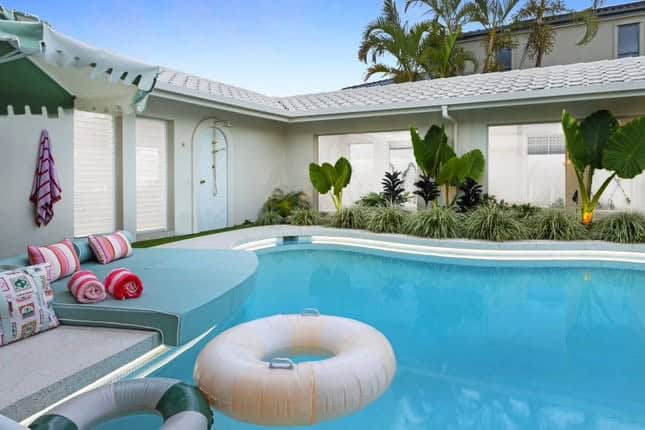
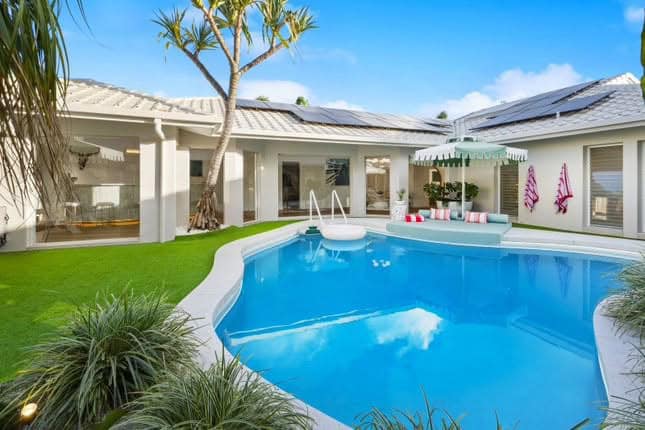
Safe Pool Design for Young Children
We hear from a lot of parents who assume safety features mean compromising on how the pool looks. That is not how we approach it. The features that keep young children safe can be some of the most considered parts of a well-designed pool. The key is building them in from the beginning.
 Gradual entries
 Gradual entries
Beach entries and wide shallow steps let young children wade in gradually without dropping straight into depth. They also double as poolside seating for adults. A beach entry spanning one end of the pool works for a toddler in 200mm of water and for a parent sitting at the edge watching. It feels like a design feature rather than a safety compromise.
Baja shelves and shallow ledges
A Baja shelf, a submerged platform typically sitting at around 200 to 300mm of depth, gives young children their own space in the water without putting them near the deeper zones. We position these facing the main living areas wherever possible, so they stay visible from the kitchen or living area. That visibility matters more than most parents realise until they are trying to watch a child in the pool while doing something else inside.
Sightlines from the house
Where the pool sits relative to your main living areas is decided on paper, before anything is built. We look at this closely when we are designing a pool because a pool in clear view of the kitchen window and the main living area gets used more safely and more often than one positioned around a corner from the house. It is a straightforward design decision that costs nothing to get right and a lot to fix after the fact.
Fencing and barriers
Queensland law requires a compliant pool safety barrier before the pool is filled to 300mm or more. We work through the fencing design as part of the pool design, not separately. Frameless glass fencing keeps sightlines open, suits contemporary homes, and does not interrupt the visual connection between the house and the pool. We factor in gate placement, latch height, non-climbable zones, and proximity to trees, decking, and windows before anything is built. For a full breakdown of what compliance involves, see our guide to pool fencing laws in Queensland.
Depth Zones That Work for Every Age
A pool with a single uniform depth works well for one age group and poorly for everyone else. When we design pools for families, we plan the depth layout around the full age span of the people who will actually use it.
 Shallow zones for toddlers and young children
 Shallow zones for toddlers and young children
We aim for 300 to 600mm in the shallow zone, though the exact depth depends on the family and how young the children are. That range gives young children room to splash and play while remaining a comfortable shallow area for supervised use. We position this zone where it maintains visibility from key living areas, which matters more at this stage than where it looks best on the plan.
Mid-depth for general family swimming
1.0 to 1.2 metres covers most of what families use a pool for: adults standing comfortably, older children swimming lengths, games that involve everyone. This tends to be the largest zone in the pools we design for families and the most used across all ages.
A deep end for older children and adults
Older children and teenagers often want enough depth for jumping, swimming, and more active games. Many family pools include a deeper section of around 1.7 to 2.0 metres where the block and intended use allow for it. That keeps the pool enjoyable as children grow and gives adults enough depth for swimming and exercise.
Graduated slopes versus defined depth breaks
A gradually sloping floor from shallow to deep gives the most flexible use across all ages and is easy to navigate. A defined step down at a specific point gives clearer separation between zones, which some families find useful for younger children understanding where their boundary is. We discuss both with families during the design process. Because we build in concrete, we can do either, or a combination of the two, on your specific block. If you are weighing up your options, our guide to concrete pools versus fibreglass pools explains the practical differences.
Designing for Entertaining as the Kids Get Older
The way a family uses a pool changes considerably over time. The pool that needed constant supervision when the children were small becomes the social hub of the house when they are teenagers. By the time they leave home, it is mainly used for weekend gatherings and the occasional quiet morning swim. A pool designed only for young children tends to feel limiting at every stage that follows.
 Seating and ledges integrated into the pool
 Seating and ledges integrated into the pool
Bench seating built into the pool shell, or a wide coping broad enough to sit on comfortably, gives people somewhere to be that is part of the space without being in the water. This is where adults end up during a party, where teenagers sit between swims, where someone perches with a drink while others are in the water. Trying to solve this problem later with outdoor furniture placed around the edge never achieves the same effect as designing it in from the beginning.
The alfresco connection
Outdoor entertaining areas work best when they are designed in relation to the pool rather than independently. A covered alfresco that faces the pool, with a deck level that meets the pool edge without a significant step, creates a space that gets used all day rather than just at meal times. We look at this connection when we are designing the pool because the two spaces function as one.
Enough length for active use
A pool that is slightly longer than strictly necessary for the block gets used very differently from one sized to the minimum. Room for inflatables, pool games, casual lap swimming, and general activity comes from pool length rather than depth. In our experience, families are far more likely to wish they had built a slightly longer pool than a shorter one.
Resale Value and Long-Term Investment
A pool that was designed to suit your family’s life also tends to suit the broadest range of future buyers. A pool built around very specific personal choices can be harder to sell.
Finishes that hold up over time
Pebblecrete finishes and tile palettes in softer blues, greens, and warm neutrals date well. Strong colour choices and unusual shapes can look dated within a decade. Buyers look at the pool as part of the overall property, and a pool that reads as well-maintained and considered adds to that assessment.
Layouts that appeal to more buyers
What buyers respond to in a family pool is largely the same as what families value when they are using it: usable entertaining space beside the water, easy supervision from the house, a pool that is low maintenance to run, and proportions that feel balanced rather than squeezed into the block. A pool built around those priorities serves the family well and reads clearly to a buyer at inspection.
Automation and running costs
Buyers factor in what a pool costs to run. Automated systems that manage filtration, heating, and sanitisation with minimal manual input are worth considering. Building provisions for automation during construction is tidier and less expensive than retrofitting it after the pool is complete.
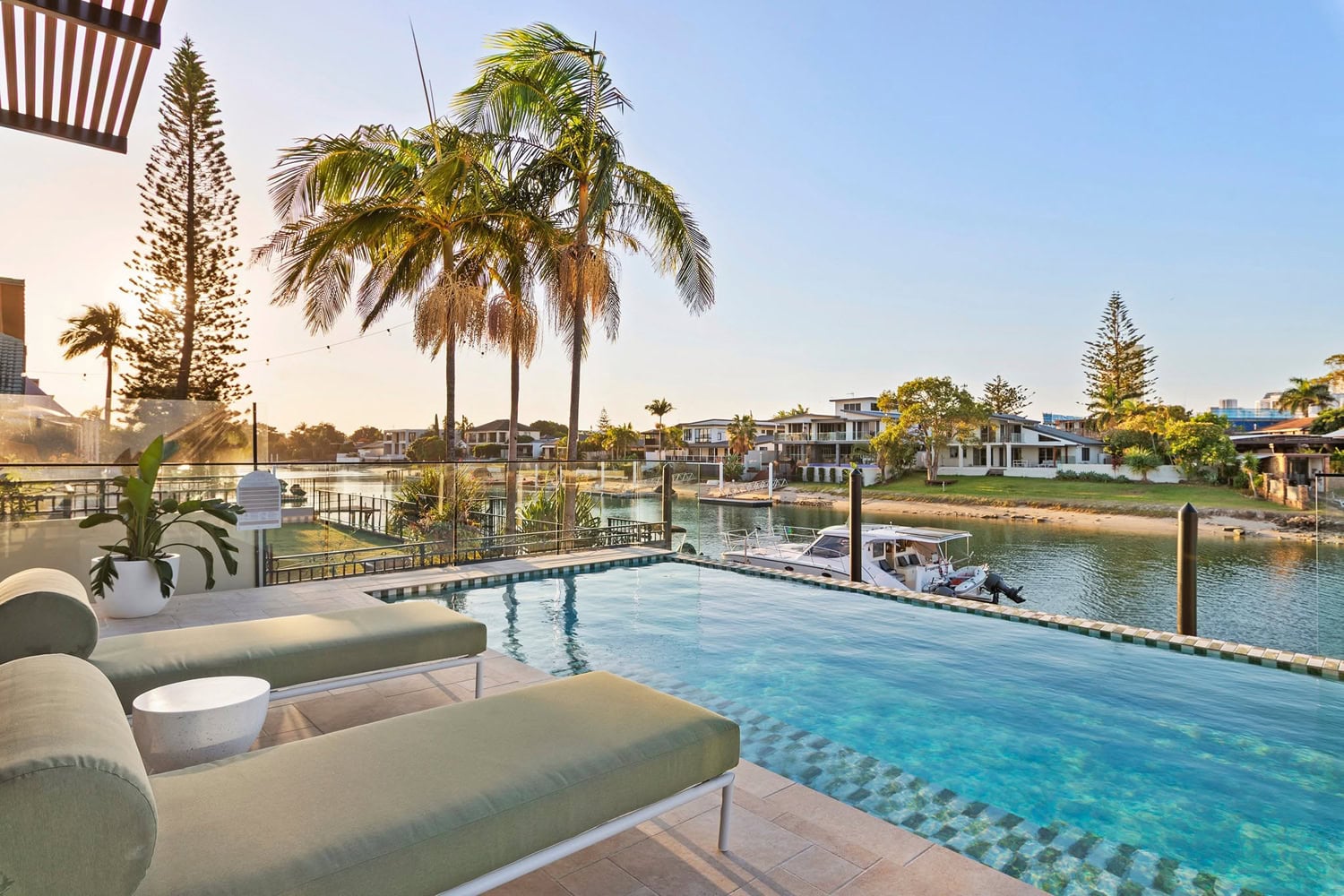
How We Design Pools for Growing Families
Every pool we build starts with a conversation about how the family uses the space. The answers shape everything from the pool’s layout and entry design to its orientation and connection with the alfresco. None of those are decisions we make in isolation from the family who will live with them.
Because we build custom inground concrete pools rather than installing fibreglass shells, we are not limited to standard sizes and shapes. We can design the pool around your block and your family rather than fitting your family to a product someone else manufactured. If your block slopes, if you have an unusual boundary configuration, or if you have a specific depth layout in mind, concrete construction gives us the flexibility to do it properly.
You can read more about how we work through each build in our pool building process guide, and if budget is on your mind, our guide to the cost of building a pool covers what to expect.
A Pool Built for Your Family, Not Just Your Backyard
The decisions that determine whether a pool works for decades are usually made before construction begins. They include where the pool sits relative to the house, how the depth is distributed, whether there is space to gather beside the water, and whether safety features were considered from the beginning. We work through all of that at the start of a project, and it stays with the pool for its full life.
If you are planning a pool on the Gold Coast or in Brisbane and want it to work for your family now and in ten years, talk to us before the plans are finalised. We offer a full range of pool building services and can help you design something that actually grows with you.
Frequently Asked Questions
How much does a family pool cost to build on the Gold Coast?
It varies depending on size, site conditions, depth configuration, and finishes. A straightforward pool on a flat block costs less than one on a sloping or canal-front site. Features like beach entries, Baja shelves, and automation add to the cost but significantly to long-term usability. Our guide to the cost of building a pool covers what to expect across different project types.
Can an existing pool be modified to add a shallow entry or Baja shelf?
Sometimes, but it involves structural work and is considerably more expensive than building those features in from the start. Fibreglass pools cannot be structurally modified once installed. Concrete pools offer more flexibility, but the disruption and cost are still significant. It is one of the strongest arguments for thinking through the full design before construction begins.
How long does it take to build a concrete family pool?
Construction typically takes eight to fourteen weeks depending on site conditions and complexity. That does not include design, approvals, and engineering, which should be factored into the overall timeline. Our pool building process guide breaks down each stage.
Do I need council approval for a family pool on the Gold Coast?
Yes. Most permanent pools in Queensland require building approval before construction starts, arranged through a private certifier. Some sites also need development approval. Pool fencing must comply with Queensland safety legislation before the pool is filled. Our Queensland pool approval guide covers the full process.
What pool heating options work best for families in Queensland?
Heat pumps are the most efficient option for the Gold Coast climate, extracting heat from the air rather than generating it. Solar heating works well where roof space and sun exposure allow. Gas heats faster but costs more to run. Building heating provisions into the electrical and plumbing setup during construction is straightforward and cheaper than retrofitting later.
Why should I choose a concrete pool over fibreglass for my family?
Concrete can be built to any shape, size, and depth configuration. That matters for family pools where the ideal layout, shallow entry, multiple depth zones, integrated seating rarely match a standard fibreglass shell profile. Concrete can also be resurfaced and modified over time. Our guide to concrete pools versus fibreglass pools explains the trade-offs in full.
What non-slip surfaces work best around a family pool?
Textured concrete, brushed or exposed aggregate paving, and porcelain tiles with a wet-area grip rating are all commonly used on the Gold Coast. The right choice depends on the design, foot traffic, and how the pool deck connects to the house. We factor this into the pool deck and coping discussion with every family we work with.
Sorry, the comment form is closed at this time.